
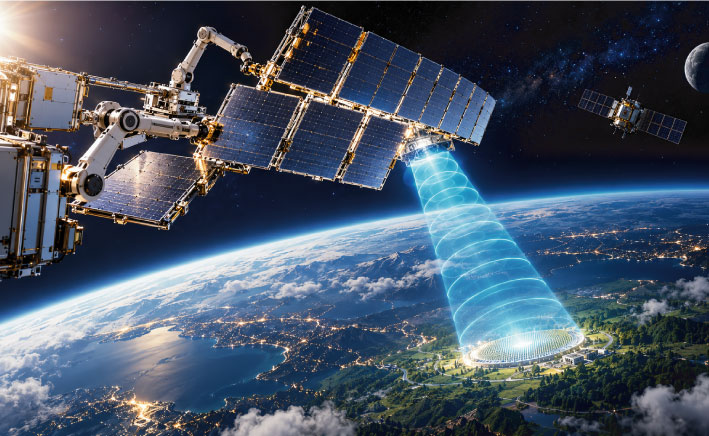
A spacecraft that builds a power station in orbit sounds like a distant technological prospect. Yet the United States is now funding a demonstration intended to do something close to that. Under the Advanced Scalable Growth Architecture for Robotic Deployment (ASGARD) program, Katalyst Space has been selected by the US Department of Defense’s Operational Energy Capability Improvement Fund to develop a robotic spacecraft that will assemble a large-format power-beaming system in orbit, working with the US Naval Research Laboratory (NRL).
The concept is straightforward. Katalyst’s NEXUS spacecraft will use robotic arms capabilities to assemble modular tiles developed by the NRL. The completed structure will collect solar energy, convert it into radio-frequency (RF) microwave energy and transmit that energy back to Earth. Katalyst describes ASGARD as a demonstration of on-orbit assembly of large-scale infrastructure for space-based solar power. The significance goes beyond the demonstration itself. If the project is successful it will show that robotic spacecraft can assemble infrastructure in orbit that is far larger, than the launch vehicles that carried them. The possibility of infrastructure raises an important governance question: are the rules that govern the orbital environment keeping pace with the infrastructure being developed within the orbital environment?
The attraction of orbital power is understandable. Space-based solar power has long been talked about as a way to provide energy without many of the limits that come with power made on Earth. For military planners, the idea of sending power to faraway places could also be useful for operations but moving from a simple idea to real infrastructure changes how the problem looks. A satellite is usually built as a single spacecraft. A large power-beaming array built in space could instead be made up of separate parts, physical links, robot connections moving pieces and a system on the ground that receives the power. This creates a set of problems related to how things work and how the environment affects them.
ASGARD is not the first effort in the United States to show that solar power from space can be sent through the air. The NRL sent its Photovoltaic Radio-frequency Antenna Module called PRAM on a flight with the US Air Forces X-37B in May 2020. PRAM was an experiment in space meant to test turning sunlight into microwave energy and to gather information about how the technology works and how it handles heat in space. The NRL called it a step towards technologies that might one day send power from space to Earth.
The NRL also did an experiment with power beaming on the International Space Station in 2020. They used a system that changed wireless radio signals into electricity. This test was more about proving a concept rather than a power generation system but it showed the basic idea of sending energy without wires in space.
The Air Force Research Laboratory (ARFL) has taken a more complete path with a project called the Space Solar Power Incremental Demonstrations and Research Project or SSPIDR. Their experiment called Arachne aims to improve the technology needed to collect power, change it into radio frequency energy, shape and direct the RF beam and send it to a place on Earth. The ARFL says Arachne is a test to improve the technology that might one day help a system that can power a place where military troops are working. There is a difference between the older experiments and ASGARD. NRL’s PRAM showed parts that can change power into radio frequency energy while in space. ARFL’s SSPIDR project has worked on showing and combining the parts needed to send power from space. ASGARD brings something building a big power-beaming structure in space using robots. The question is no longer just if the separate parts can make and send power. It is also if robot systems can build, use and take care of a bigger setup, in space. This change makes lifecycle governance more important.
Public descriptions of the ASGARD programme provide relatively little detail about some basic parameters. What orbit will the system occupy? How large will the completed array be? What will happen if robotic assembly fails halfway through? How would a partially assembled structure be stabilised or removed? What is the plan for disposing of the system at the end of its operational life? These questions are not arguments against the project. They are questions about whether orbital infrastructure is being governed according to its entire lifecycle. The challenge is not preventing innovation in space. It is ensuring that innovation does not externalise its risks onto an environment shared by everyone. There are already international rules that deal with parts of this issue but those rules were not created with large commercially run, robotically built power systems in space in mind.
The issue becomes more complicated when the power beam itself is considered. The system will transmit energy from orbit to a receiving location on Earth using microwaves. The environmental and safety implications depend on technical characteristics that are not incidental: transmission frequency, beam width, power density, pointing accuracy and the procedures used if the beam deviates from its intended target. There are also scientific questions about interactions between high-power microwave transmission and the ionosphere. These do not establish that space-based power beaming will damage the atmosphere. They do, however, demonstrate why modelling and monitoring should accompany increasingly powerful demonstrations.
The terrestrial receiving site introduces another layer of responsibility. A system designed to transmit substantial energy from orbit ultimately concentrates that energy on infrastructure on Earth. Questions surrounding land use, electromagnetic exposure, communications interference and ecological effects therefore become part of the system’s footprint. The appropriate response is not to assume that these effects will be harmful. It is to establish a baseline against which they can be measured.
The governance problem becomes more clear when Katalyst’s other activities are considered. Its NEXUS spacecraft is being developed for satellite servicing, deorbiting and other orbital operations. The company recently received a Defense Innovation Unit (DIU) contract under the Deorbit-as-a-Service programme to develop capabilities for rendezvousing with and deorbiting Space Development Agency satellites that were not originally designed to be serviced. Its attempted mission to rescue NASA’s Swift Observatory also demonstrated the difficulties involved in complex proximity operations. LINK experienced attitude-control problems and was ultimately unable to perform the planned rescue. NASA subsequently ended its involvement in the Swift boost effort, while LINK continued limited proximity-operation activities before reentering the atmosphere and ending the mission.
Private companies are no longer simply providing launch services, communications or imagery. They are increasingly being asked to perform activities that alter the physical configuration of the orbital environment. That creates a governance challenge for governments. When commercial companies build or manipulate infrastructure in space under government contracts, responsibility can become distributed across the operator, contractor, customer and regulator. Yet the orbital environment itself cannot be divided in the same way.
A spacecraft operator may own its vehicle, but it does not own the orbital environment. A collision can affect unrelated operators. A failed structure can become a debris problem. Spectrum use can affect other users. International spectrum use is governed in part by the ITU Radio Regulations, which establish the international framework for radio-frequency assignments and interference management. A terrestrial receiving site can create environmental questions beyond the boundaries of the space programme itself. This is where the power-beaming experiment becomes a useful test case. Existing international rules already provide part of the framework. The 1967 Outer Space Treaty requires states to authorize and continuously supervise the activities of non-governmental entities in outer space, while also establishing obligations concerning responsibility, liability and potentially harmful interference. The United States has an opportunity to establish expectations before such systems become commonplace. Operators could be required to publish basic information about operating orbits, physical dimensions, assembly procedures, failure modes and end-of-life disposal. Transmission systems could be accompanied by publicly available information about frequency, beam characteristics and ground-level power density. Receiving sites could establish ecological and electromagnetic baselines before sustained operations begin. Such requirements would not necessarily slow technological development. They could instead provide the evidence needed to distinguish manageable risks from genuinely unresolved ones. There is a broader strategic reason to do this.
As space becomes increasingly important to national security, governments have an interest in ensuring that new infrastructure does not create avoidable vulnerabilities. A large orbital structure must be resilient not only to engineering failures but also to congestion, debris, interference and hostile action. Environmental governance and strategic resilience therefore increasingly overlap. The lesson from ASGARD should not be that ambitious space projects should be stopped. Nor should it be that technological promise is sufficient justification for deployment. It is that the definition of responsible innovation is changing.
For decades, space policy largely revolved around putting individual spacecraft into orbit and keeping them operational. The next generation of systems may involve assembling, servicing, moving and eventually dismantling infrastructure in space which requires a corresponding evolution in governance.
Space-based power may ultimately prove technically viable or economically impractical. The ASGARD demonstration will help answer some of those questions. But the more important question for policymakers is already visible. If governments are prepared to fund increasingly ambitious infrastructure in orbit, they should also be prepared to require the environmental accounting that makes such infrastructure sustainable. The future of space power should not be built on the assumption that consequences can be addressed later.
Author: Nimra Javed, Research Officer, Center for International Strategic Studies, AJK.
