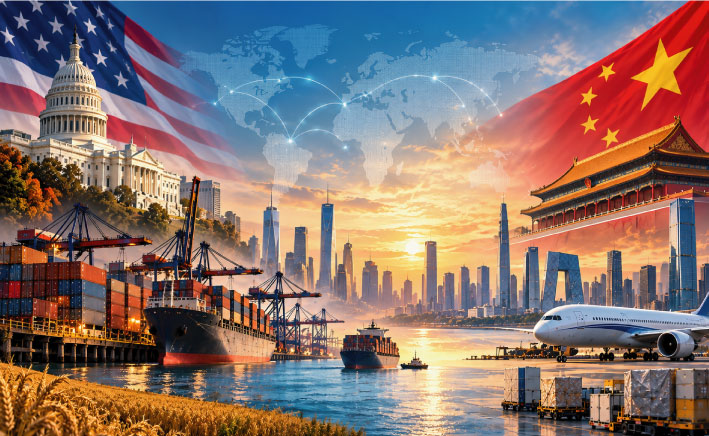
The U.S.-China May 14-15, 2026, bilateral summit in Beijing marks a crucial realignment of U.S.-China relations. The next trade results, announced on May 16, 2026, followed a highly aggressive tariff campaign in early 2025, under the banner of “Liberation Day.” The U.S. White House and China’s Ministry of Commerce announced a positive consensus after a 9-hour meeting. Still, the context of this meeting suggests that both governments are under extreme internal economic and political pressure.
A clear-cut foreign policy success was a must for the Trump administration, which began a politically difficult midterm election campaign amid shrinking manufacturing jobs, rising inflation, bankruptcies, and an undecided war with Iran. For Xi Jinping, on the other hand, the meeting was a chance to move the two countries’ relationship from an anarchic state of “balancing” toward a more stable and organized pattern of “managed rivalry.” But the most significant benefit the summit offered was not the commercial contracts but the bilateral deal-making that leaves American security in the Indo-Pacific in the hands of transactions. The Trump administration began its “Liberation Day” tariff program on April 2, 2025, imposing a blanket 10% tariff on all imports, followed by 57 additional country-specific tariffs that would raise tariffs on many imports to restore U.S. manufacturing and plug the ongoing trade deficit. Then, average duties on Chinese goods in the U.S. increased from 34% to a new high of 145% in the weeks that followed, before Beijing responded with retaliatory tariffs of 125%. This framework is aggressive, built on the assumption that foreign companies will pass costs on, thereby shifting the global supply chain to the United States. Rather, macroeconomic data for the coming year showed that the “Liberation Day” policy had set up a domestic economic trap.
Moreover, the tariffs didn’t accomplish what they were designed to do: stimulate manufacturing and reduce the trade deficit. Overall, the U.S. goods trade deficit reached a record high in 2025. The tariffs have cost U.S. manufacturing 100,000 jobs since they took effect, even as manufacturing employment has fallen to its lowest share of all nonfarm jobs since 1939. The agricultural industry was devastated, with U.S. agricultural exports falling further. The agricultural trade deficit grew by 10.8% to $41 billion in 2025, leaving a record number of American farmers “financially underwater” and prompting the government to consider large-scale bailouts. This domestic economic crisis was exacerbated, prompting the Trump administration to seek a tactical de-escalation. The initial trade agreement results, announced on May 16, 2026, were intended to appease the Trump administration rather than address fundamental systemic trade problems between countries. The agreement covers five areas: selective tariff adjustments, new trade and investment councils, expanded access to agriculture, increased two-way trade, and cooperation on the aerospace supply chain. The biggest advance for the manufacturing industry was China’s solidification of its purchase of 200 Boeing planes, with an option to buy as many as 750 additional planes. This agreement reopens the market, which had previously accounted for one-third of Boeing’s narrow-body orders and had been closed after the deterioration of bilateral relations. GE Aerospace is also directly benefiting from the aerospace deal, as it is projected to deliver between 400 and 450 engines to Chinese aviation companies.
Most importantly, this deal reveals a fundamental fault line in U.S. policy. Key American industrial giants remain heavily dependent on Chinese commercial demand. In exchange, Beijing insisted on assurances of U.S. engines and high-tech aviation technology for these purchases, while also developing its own engines and supplies to secure its own supply chains. The White House announced that China will spend $17 billion on U.S. agricultural goods over the next three years (2026, 2027, and 2028), including soybeans, beef, and energy. The United States offered to relax regulations to open the market to Chinese dairy and seafood products, among others, in return for those concessions. The high-profile visit to China by 17 American business leaders has highlighted the transactional nature of these deals, with Tesla’s Elon Musk, Nvidia’s Jensen Huang, Citigroup’s Jane Fraser, and Qualcomm’s Cristiano Amon among the leading business executives joining the delegation. The summit offered much-needed regulatory relief for these multinationals, which continue to earn 52% of their business in China despite the trade war. However, taken together, the agreements remain relatively small and do not do enough to shift the underlying mercantilist policies, state-led subsidies, and national security measures that still separate the two economies.
The business deals through which Trump secured real-world results for his domestic base also achieved Beijing’s main objective, the creation of a new strategic deal. President Xi Jinping advanced the concept of “constructive strategic stability” to guide bilateral cooperation over the next three years. In fact, Beijing has chosen “constructive strategic stability” as a model for “managed rivalry” rather than a subordinate role in a unipolar world. Chinese state leadership has clearly outlined this framework of four pillars of stability. First, positive stability makes cooperation the central pillar of the relationship. Second, sound stability acknowledges the inevitability of competition and seeks to keep it within healthy, moderate bounds. Third, stability as a constant stress means that the management of existing geopolitical and economic differences is handled through institutional mechanisms. Lastly, a stable end is a stable peace, to be achieved through diplomatic and respectful relations between heads of state.
In practice, this strategic stability will enable the two superpowers to divide their relationship: it will be intensified in areas where technology is highly sensitive, such as artificial intelligence and advanced semiconductors, while it will be enhanced in other non-sensitive areas of commerce, such as agriculture and civil aviation. Within this framework, both countries have agreed to establish a Board of Trade and a Board of Investments. The Board of Trade is expected to present concrete pledges on tariffs and market access, but the Board of Investments is likely to have a lot of work to do. However, the diplomatic thaw has paved the way for President Xi to visit the U.S. in the fall of 2026, with pledges to cooperate on Middle Eastern security, notably a ceasefire and the reopening of the Strait of Hormuz.
The far-reaching implications of the May 2026 trade agreements lie in the stark contrast between geopolitical stability and the struggle of everyday people to make a living. The emotional escalation is replaced by sound strategic stability, which will directly and immediately benefit the financial market, corporate elites, and international businesses. The lifting of direct tariff warfare should bring some calm to global supply chains, dampen import volatility, and, in the long run, lower import prices for consumer goods. However, the high-level détente is not enough to solve the systemic economic problems faced by the common people. The Trump administration may have an annual farm purchase bonanza of $17 billion. Still, the farm problems of mounting bankruptcies, expensive farm machinery, and ever-rising farm debt remain unsolved. Not all of this structural damage, much of it inflicted over the years by tariff wars, from a sharply shrunken manufacturing base to a rising consumer cost of living, is cured by a few symbolic buyouts.
The soaring prices of housing and healthcare, low wages, and continued inflation have been eroding the average family’s standard of living. It’s the ultimate paradox of modern economic diplomacy: governments proclaim the benefits of the partnership, and markets toast its stability, yet the average citizen still wonders why life is harder every year. The Beijing summit has helped establish temporary rules of engagement to address the rivalry between two great powers, but the future of Indo-Pacific stability remains fraught with uncertainty. The Trump administration has sidelined structural economic shifts in favor of short-term, politically significant purchasing decisions, thereby sacrificing credibility on regional security. The White House’s “negotiating chip” tactic with Taiwan has added a troubling layer for the future of their relations.
The summit is a major diplomatic success for Beijing. It has effectively established a mechanism for “constructive strategic stability,” giving the country sufficient leeway to make domestic economic adjustments and reforms and to continue advancing strategic self-reliance in advanced technology. The summit is also a stark reminder to Taipei of the limits of relying on great-power security guarantees, and a domestic political debate over how to maintain Taiwan’s sovereignty in a more transactional global order is brewing. This brief interlude of peace is not a solution to the fundamental competition between the world’s two largest economies, but rather a tactical pause that the world must recognize as such before President Xi heads to the United States for his planned visit in fall 2026. The core tensions in the relationship, including advanced-technology rivalry, structural trade tensions, and Taiwan’s geopolitical role, remain unresolved and could resurface as domestic political pressures in either country shift.
Author: M. Shahzad Akram is a Research Officer at the Centre for International Strategic Studies, AJK. He holds an MPhil in International Relations from Quaid-i-Azam University, Islamabad. He is an alumnus of the Near East South Asia (NESA) Centre for Strategic Studies, National Defence University (NDU), and Washington, DC. His expertise includes cyber warfare and strategy, arms control, and disarmament.
