
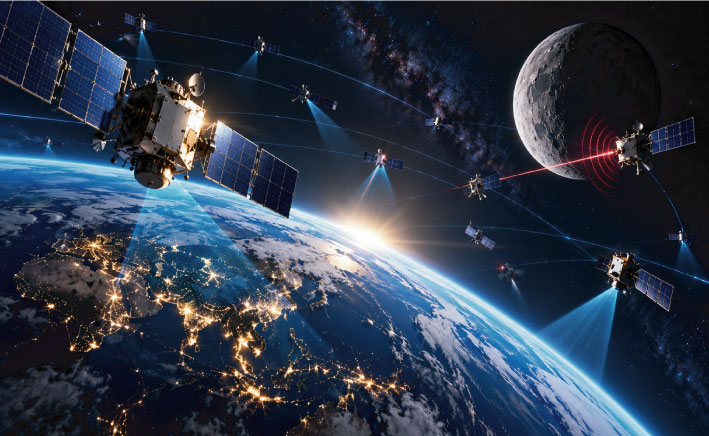
The United States has confirmed for the first time that it has deployed a weapon into orbit, marking a significant development in the militarisation of space. US Secretary of the Air Force Troy Meink said the “on-orbit” weapon was necessary to protect US forces against hostile action, but offered no details about its capabilities, when it was deployed, or how it operates and that lack of information matters. It is tempting to assume that the United States has placed interceptor missiles or some futuristic “space weapon” in orbit, but the available evidence does not establish this. US Space Force doctrine uses the broader concept of “space control”, which includes both offensive and defensive capabilities, ranging from electronic warfare and jamming to potentially kinetic systems.
Experts have therefore cautioned against drawing conclusions about the particular technology involved. It could, for example, be an electronic-warfare platform capable of disrupting communications, or a system designed to interfere with another satellite. A physically destructive weapon is another possibility, although destroying objects in orbit creates the additional problem of dangerous debris. What is clear is that the United States has now acknowledged that at least one weapon intended to affect the space domain is already on orbit. That is strategically important even if we do not yet know precisely what the weapon can do.
Space has been militarised for decades. Satellites provide intelligence, surveillance and reconnaissance, communications, navigation and missile warning, making them indispensable to modern military operations and civilian life. The US, Russia, China and other countries have consequently developed capabilities to interfere with or attack satellites. Many of these capabilities do not involve putting weapons in space. Ground-based systems can jam communications, spoof navigation signals, conduct cyberattacks or, in some cases, physically destroy satellites. The US, China, Russia and India have all demonstrated anti-satellite capabilities, although the resulting debris from destructive tests has highlighted the dangers of such weapons to every country’s spacecraft.
The new development is different because the weapon itself is reportedly in orbit which does not automatically mean that a new “Star Wars” era has begun. But it does represent another step towards treating space as an operational military battlefield rather than simply infrastructure that needs to be protected. There is also an important legal distinction.
The 1967 Outer Space Treaty prohibits countries from placing nuclear weapons or other weapons of mass destruction in orbit. It does not, however, prohibit all conventional weapons from being placed in Earth orbit. The treaty therefore cannot simply be described as a comprehensive ban on space weapons. This distinction was particularly important when concerns emerged in 2024 about a possible Russian space-based nuclear capability. At the time, it was necessary to distinguish between a nuclear weapon, a nuclear-powered satellite and other counter-space technologies.
The latest US announcement raises a different question. If the weapon is conventional, its mere presence in orbit does not by itself establish a violation of the Outer Space Treaty. Its operation would still be subject to other obligations under international law, including the UN Charter and, during armed conflict, international humanitarian law.
The bigger concern may therefore be strategic rather than purely legal. A weapon in orbit could increase the uncertainty surrounding military activity in space. Satellites can manoeuvre, approach one another and conduct operations that are difficult for outsiders to interpret. If one country’s satellite suddenly stops transmitting, for example, was it a technical failure, a cyberattack, electronic interference or an intentional attack?
Such ambiguity can become particularly dangerous when satellites support nuclear early-warning and command systems. A malfunction or unexplained loss of a satellite could potentially be misinterpreted as an act of aggression. In a crisis between nuclear-armed states, decisions made under uncertainty could have consequences far beyond space. This is why the emergence of military capabilities in space needs to be accompanied by greater transparency and communication, rather than simply more weapons.
The announcement also comes as the Trump administration develops the Golden Dome missile-defence system, which is expected to rely heavily on space-based sensors and potentially space-based interceptors. The United States has described space-based capabilities as an important component of its future missile-defence architecture. It would be premature, however, to assume that the newly acknowledged orbital weapon is part of Golden Dome. The US government has not made that connection publicly.
However, both developments reflect a broader change in US strategic thinking i.e., space is increasingly being treated as a domain in which military forces must be able not only to defend satellites, but also to operate against hostile space capabilities. China has already criticised the US announcement, warning that the expansion of military capabilities in space could fuel an arms race. Russia has also continued to call for restrictions on the deployment of weapons in orbit. These reactions should be understood as the positions of governments with their own strategic interests. But they nevertheless demonstrate the central problem, for instance, when one major power develops a new capability, others must decide whether it is defensive, offensive or potentially both. The resulting security dilemma is familiar. One country develops a capability because it fears the vulnerability of its satellites. Another sees that capability as a threat and develops its own response. The first country then interprets that response as confirmation of its original fears. The result can be an arms race without either side initially intending to start one.
The most dangerous future for space security is therefore not necessarily one filled with spectacular satellite battles. It is one in which increasingly sophisticated systems operate in orbit while governments lack common rules for understanding their activities. The international community has already recognised the dangers of destructive anti-satellite weapons and the long-lived debris they create. The next challenge is to address the wider range of military capabilities now emerging in space, including weapons that may disable rather than destroy.
The US announcement should therefore be treated neither as proof of a futuristic space war nor as an isolated technological development. It is a warning that the military competition surrounding space is entering a new phase. The priority should be to establish greater transparency about dangerous capabilities, improve communication between space powers, strengthen norms against debris-producing attacks, and protect satellites supporting civilian and nuclear-warning systems. Space is becoming increasingly important to national security. But it remains a shared environment. The objective should not be to achieve permanent military dominance of it, but to ensure that competition in space does not create the conditions for a conflict on Earth.
Author: Nimra Javed, Research Officer, Center for International Strategic Studies, AJK.
